Commercial workflow page

U.S. E-SIGN and UETA Workflow for PDF Records

How the DullyPDF signing pipeline maps to 15 U.S.C. §§ 7001-7003, UETA §§ 5, 7, 8, 9, 12, and New York ESRA 9 NYCRR Part 540.

Workflow examples for E-SIGN / UETA PDF Workflow

DullyPDF signature workflow used as the operational basis for supported U.S. e-sign record handling.
The compliance discussion still points back to a real product behavior: one frozen PDF, one signer ceremony, and retained signing artifacts.

E-sign pipeline

DullyPDF E-Sign Pipeline — every signing workflow, every industry

Single-signer, sequential multi-signer, parallel multi-signer, Fill By Link → sign, group fill → multi-sign, and API Fill → sign — walked end to end across HR onboarding, healthcare intake, real estate, legal, insurance ACORD, and immigration USCIS workflows.

E-sign walkthroughWatch on YouTube

Use this video as the canonical reference for DullyPDF e-signatures: pick the signing workflow your team actually runs, then match it to the industry-specific packet you already send out today.

What this page covers and what it does not claim

This page explains how the DullyPDF signing pipeline is designed around the core U.S. rules that matter for supported electronic signature workflows.1a3a It is not a substitute for legal advice, and it is not a promise that every document or industry program becomes compliant simply because a PDF can move through an electronic ceremony. The page is intentionally narrower than that.

The right public claim is that DullyPDF supports an immutable-record PDF signing workflow designed around E-SIGN, UETA, and certain state-law concepts for supported records.1b3b4a The wrong claim is that DullyPDF is the compliance answer for every document, every state filing system, every notarization regime, every regulated consumer disclosure program, or every industry that has its own electronic-record requirements beyond E-SIGN.

The transaction model: two intake paths, one immutable record

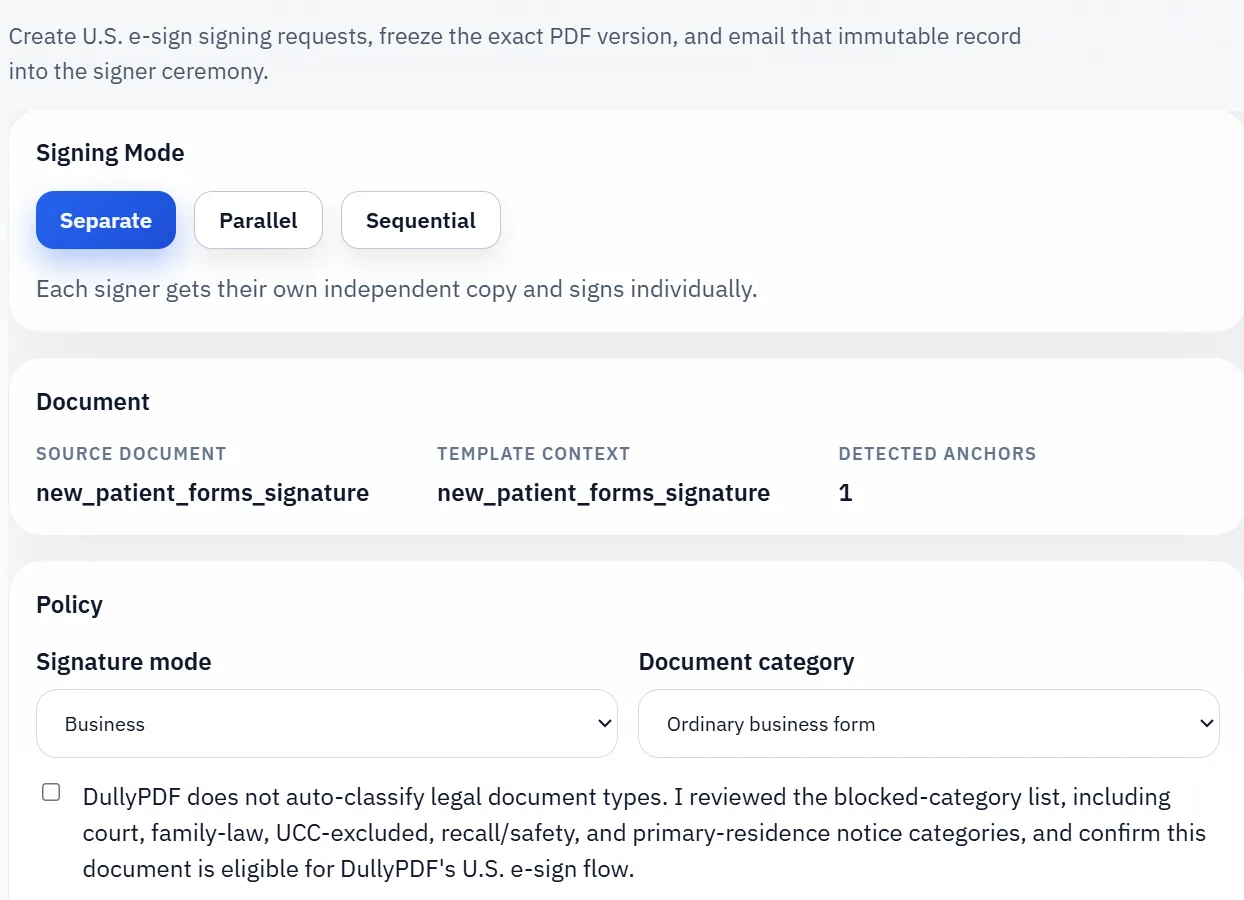
DullyPDF supports two operational starts. The first is direct email-first signing, where the owner already has the final PDF. The second is Fill By Web Form to sign, where the public respondent answers a hosted HTML form first and the system materializes the final PDF from that stored response before signature. In either case the signing ceremony begins only after one immutable PDF exists for the request.

That model matters because both E-SIGN and UETA are concerned with records, not just visible marks. The product therefore orients the workflow around the record that will be retained later. The signer is asked to review and act on that one record. The owner later retrieves that same record set from the workspace. That is the core architectural point behind the statutory mapping that follows.

  • Email-first path: current PDF -> immutable snapshot -> signer email -> ceremony -> artifacts.
  • Web-form-to-sign path: stored response -> materialized filled PDF -> signer email -> same ceremony -> artifacts.
  • One request always resolves to one retained immutable source PDF before signature completion.

15 U.S.C. § 7001(a), § 7001(b), UETA § 7, and UETA § 8: legal recognition, writing, and consent to transact electronically

15 U.S.C. § 7001(a)(1)-(2) is the federal starting point: a signature, contract, or record generally may not be denied legal effect solely because it is electronic.1c UETA § 7 expresses the same recognition rule in the uniform-state-law model.3c UETA § 8 addresses when a legal requirement for a writing is satisfied by an electronic record.3d DullyPDF is aligned to that model by producing one retained electronic PDF record and collecting the signature act inside a ceremony logically associated with that record.

15 U.S.C. § 7001(b)(1) is equally important because it says E-SIGN does not wipe away other substantive obligations.1d If some other law imposes content, timing, delivery, disclosure, or retention duties, those duties still exist. 15 U.S.C. § 7001(b)(2) also matters because no person is required to agree to electronic records or signatures.1e DullyPDF respects that by keeping manual fallback available rather than assuming an electronic ceremony is mandatory for every signer or every document.

UETA § 5 also matters conceptually because UETA generally applies when the parties have agreed to conduct transactions by electronic means.3e In product terms, that is why DullyPDF positions the signing flow as a supported workflow choice for appropriate records rather than a magic layer that can be dropped onto every possible document. The product can control the ceremony mechanics. It cannot force the legal appropriateness of electronic execution for a transaction the business should not have routed electronically in the first place.

  • 15 U.S.C. § 7001(a)(1)-(2): electronic form alone does not defeat validity.1f
  • 15 U.S.C. § 7001(b)(1): E-SIGN preserves other legal duties besides the paper-or-signature form requirement.1g
  • 15 U.S.C. § 7001(b)(2): the signer cannot simply be forced to accept electronic records.1h
  • UETA § 7: legal recognition of electronic records and signatures.3f
  • UETA § 8: writing requirements can be met by electronic records.3g
  • UETA § 5: the transaction still has to be one the parties agreed to conduct electronically.3h

15 U.S.C. § 7001(c)(1)(A)-(C): consumer disclosure, consent, and access demonstration

The biggest legal difference between ordinary business requests and consumer electronic records appears in 15 U.S.C. § 7001(c)(1)(A)-(C).1i When a law requires information to be provided to a consumer in writing, the sender needs affirmative consent, prior disclosures, and an electronic consent or confirmation process that reasonably demonstrates the consumer can access the form of electronic record that will actually be used. That is why DullyPDF splits business-mode and consumer-mode ceremony behavior instead of pretending every request can use the same short path.

In consumer mode, DullyPDF stores a server-defined disclosure package, requires a distinct consent step, presents hardware and software expectations, supports withdrawal before completion, and requires an access demonstration tied to the format used in the ceremony. That is the product translation of 15 U.S.C. § 7001(c)(1)(B)(i)-(iv) and § 7001(c)(1)(C)(ii).1j The point is not to decorate the page with legal citations. The point is to show why the ceremony is actually different when consumer electronic-record consent rules apply.

The business still must ensure the disclosure text is appropriate for its use case and that operational promises are real. If the disclosure says the consumer can request paper copies, withdraw consent, or update contact information, the business needs the support process to honor those commitments. Product controls help, but they do not replace internal operations or legal review of the disclosure language.

  • 15 U.S.C. § 7001(c)(1)(A): affirmative consent is required.1k
  • 15 U.S.C. § 7001(c)(1)(B)(i)-(iv): disclosures must cover paper copies, withdrawal, scope, and hardware/software requirements.1l
  • 15 U.S.C. § 7001(c)(1)(C)(ii): consent must reasonably demonstrate access to the electronic form used.1m
  • DullyPDF consumer mode exists because consumer-record consent is not the same problem as ordinary business signing.

15 U.S.C. § 7001(d), § 7001(e), and UETA § 12: retention, accuracy, and later accessibility

A signature workflow is not complete once the browser says “done.” 15 U.S.C. § 7001(d)(1) requires retained electronic records to accurately reflect the information in the contract or other record and remain accessible for later reference.1n 15 U.S.C. § 7001(e) deals with accuracy and the ability to retain records.1o UETA § 12 likewise recognizes electronic records for retention purposes if the information remains accessible for later reference.3i That is why DullyPDF stores the immutable source PDF, the final signed PDF, and the audit artifacts together.

This is also why retention is not just a marketing afterthought. The platform can preserve records and make them retrievable, but the business must still decide whether the configured retention period is enough for the governing legal regime. Seven years may be reasonable for many ordinary business cases. It is not a universal answer for every statute, every claim period, every regulator, or every industry recordkeeping duty.

The right public promise is therefore specific: DullyPDF is built to retain reproducible signed artifacts for supported workflows. The wrong promise is that retention is “handled forever” or that the platform automatically satisfies every sector-specific retention requirement without regard to the governing law of the underlying transaction.

UETA § 9 and 9 NYCRR 540.4: attribution and logical association

UETA § 9 focuses on attribution and the effect of electronic records and signatures when they are attributable to a person.3j 9 NYCRR 540.4(b) similarly describes an electronic signature as an electronic sound, symbol, or process attached to or logically associated with an electronic record and executed or adopted with intent to sign.4b The important implementation point is that attribution is evaluated from the act and surrounding circumstances, not from a bare image pasted onto a page.

DullyPDF therefore builds the ceremony around signer actions and request state, not around a visual mark alone. The signer enters a specific request, reviews a specific immutable PDF, adopts a signature inside the same process, and completes the request inside the same session boundary. That design is materially stronger than a generic “draw anywhere on a PDF” flow when later questions arise about what record was signed and how the act was associated with that record.

That still does not mean every identity problem is solved by the platform. Email OTP and session controls help with the supported product scope. Higher-assurance identity proofing, witness-managed execution, or external credential requirements can still call for separate controls or separate providers depending on the transaction type.

15 U.S.C. § 7001(g), 9 NYCRR Part 540, and N.Y. Real Prop. Law § 291-i: notarization, acknowledgment, and recording are separate programs

15 U.S.C. § 7001(g) states that if another law requires a signature or record to be notarized, acknowledged, verified, or made under oath, that requirement is satisfied only if the authorized person’s electronic signature and the other required information are attached to or logically associated with the record.1p That is not the same thing as an ordinary signer ceremony. It is a reminder that notarization and acknowledgment bring their own role-specific requirements.

New York illustrates the point clearly. 9 NYCRR Part 540 gives electronic signatures and records legal force in many settings and establishes standards for how signatures and records are handled.4c But 9 NYCRR 540.7 and N.Y. Real Prop. Law § 291-i address real-property recording and the standards governing electronic recording systems.4d5a Those are separate controls, separate participants, and separate risk profiles from an ordinary business PDF signing flow.

So DullyPDF should talk plainly about this boundary. The platform supports supported-signing workflows. It is not marketed as the recording officer system, the notary platform, the county eRecording gateway, or the complete compliance stack for notarized and recorded instruments.

15 U.S.C. § 7003: the federal excluded categories are not edge cases

15 U.S.C. § 7003 is where many overbroad e-sign claims fall apart.2a The statute excludes wills, codicils, and testamentary trusts under § 7003(a)(1). It excludes adoption, divorce, and other family-law matters under § 7003(a)(2). It excludes official court documents, including court orders or notices, pleadings, and other writings required to be executed in connection with court proceedings. Those are not minor footnotes. They are direct statutory reasons not to advertise a general self-serve PDF signing workflow for those categories.

Section 7003(a)(3) also excludes the Uniform Commercial Code other than sections 1-107 and 1-206 and Articles 2 and 2A.2b In practice that means you should not market DullyPDF as the ordinary self-serve solution for excluded UCC records such as negotiable instruments, funds-transfer records, letters of credit, documents of title, investment securities, or secured transaction records. They may be electronic in some settings, but the general E-SIGN path is not the blanket rule there.

Section 7003(b) adds additional protected consumer-notice categories: court-ordered notices or official notices related to the cancellation or termination of utility services; default, acceleration, repossession, foreclosure, or eviction notices for a primary residence; cancellation or termination of health insurance or life insurance benefits, excluding annuities; product recall or material-failure safety notices; and hazardous-material transport or handling papers.2c Those categories should stay blocked from ordinary self-serve positioning.

  • 15 U.S.C. § 7003(a)(1): wills, codicils, testamentary trusts.2d
  • 15 U.S.C. § 7003(a)(2): family-law matters and official court documents.2e
  • 15 U.S.C. § 7003(a)(3): excluded UCC records outside sections 1-107, 1-206, and Articles 2 and 2A.2f
  • 15 U.S.C. § 7003(b): utility shutoff, primary-residence foreclosure or eviction, certain insurance cancellation, product safety recall, and hazmat notices.2g

Which records are a good fit for the current DullyPDF signing scope

The best fit is supported ordinary business records that can be routed to one signer per request and preserved as one final PDF with later owner retrieval. That includes engagement letters, service agreements, statements of work, routine contract acceptances, vendor acknowledgments, onboarding packets, handbook acknowledgments, policy acknowledgments, equipment issue or return receipts, delivery receipts, work-order completion forms, inspection acknowledgments, volunteer releases, and similar records.

Intake and authorization flows are also a good fit when the business separately handles any domain-specific requirements beyond the signing ceremony itself. Examples include routine client intake packets, standard consent or authorization forms, routine intake acknowledgments, and web-form-first information capture that needs to become one retained PDF before signature. The product is strongest when the goal is clear: one signer, one record, one artifact chain, and one owner retrieval path.

That is why these pages target ordinary business and operational search intents. They are a better fit for the actual workflow than trying to rank for every specialized legal or regulated-signature term on the internet.

What E-SIGN does not replace: specialized regulatory programs still exist

15 U.S.C. § 7001(b)(1) matters because it preserves legal duties other than the requirement that a record be written or signed in paper form.1q That means sector-specific programs can still impose their own electronic-delivery or recordkeeping rules. A general PDF signing workflow does not automatically satisfy them just because E-SIGN exists.

Examples help. Debt-collection disclosures sent electronically can implicate 12 CFR § 1006.42 and related Regulation F rules about actual notice and later accessibility.6a Employee-benefit plan disclosures can implicate 29 CFR § 2520.104b-1 and related electronic-disclosure safe harbors.7a FDA-regulated electronic records can implicate 21 CFR Part 11, including system controls and signature-accountability rules.8a Those are different compliance programs with different control expectations.

DullyPDF should therefore market itself accurately: it supports supported-signing workflows for supported records. If a business wants to use the platform inside a more regulated program, that business still needs legal review of the governing statute or regulation and may need additional operational or technical controls beyond the default product workflow.

Responsibility boundaries: what DullyPDF provides and what the sender still must own

DullyPDF provides workflow controls for supported transactions: immutable-PDF creation, signer ceremony sequencing, consumer-mode consent controls, session gating, retained artifacts, and owner retrieval. Those are real controls and they matter. They are also not the end of the analysis.

The sender or business still owns document classification, signatory authority, industry-specific disclosure content, whether the transaction is one the parties may and should conduct electronically, whether paper-copy and withdrawal promises are fulfilled in practice, whether witness or notary steps are required, whether separate identity proofing is needed, and whether the chosen retention settings satisfy the governing legal regime. That is the correct responsibility split.

That is also the right answer to the “who is at fault” instinct. The public page should not try to say DullyPDF is never at fault. It should explain the actual boundary: the product controls the supported ceremony and artifact pipeline, while the business remains responsible for legal classification and external obligations the platform cannot know or perform automatically.

Why teams use E-SIGN / UETA PDF Workflow

  • Map the actual DullyPDF signing behavior to the federal and uniform-law provisions most relevant to supported e-sign workflows.
  • Separate supported ordinary-business records from excluded categories, state-recording programs, notarization flows, and specialized regulated-delivery regimes.
  • Explain which controls live in the product and which remain the sender’s or business’s responsibility.
  • Give legal-intent searchers a detailed page grounded in statutory sections and operational boundaries rather than vague “fully compliant” marketing.

Implementation signals for E-SIGN / UETA PDF Workflow

  • 15 U.S.C. § 7001(a)(1)-(2), UETA § 7, and UETA § 8 support the core recognition and writing-equivalence model behind the immutable-PDF ceremony.1r3k
  • 15 U.S.C. § 7001(c)(1)(A)-(C) drives the consumer disclosure, consent, and access-demonstration flow in consumer-mode requests.1s
  • 15 U.S.C. § 7001(d)(1), 15 U.S.C. § 7001(e), and UETA § 12 drive the retention and reproducibility model for immutable source PDFs, signed PDFs, and audit artifacts.1t3l
  • 15 U.S.C. § 7003 and 9 NYCRR Part 540 show why excluded records, recording programs, notarization flows, and specialized regulated documents should not be folded into the ordinary self-serve promise.2h4e
  • 15 U.S.C. § 7001(b)(1) preserves other substantive duties, which is why sector-specific regimes such as 12 CFR § 1006.42, 29 CFR § 2520.104b-1, and 21 CFR Part 11 are not absorbed automatically by a general PDF signing workflow.1u6b7b8b

Need deeper technical details about e-sign / ueta pdf workflow? Use the Rename + Mapping docs and Search & Fill docs to validate exact behavior.

Frequently asked questions about E-SIGN / UETA PDF Workflow

What U.S. laws does this signing workflow target?

The workflow is designed around 15 U.S.C. §§ 7001-7003, UETA §§ 5, 7, 8, 9, and 12, and, where relevant to state treatment of electronic signatures and records, New York ESRA concepts in 9 NYCRR Part 540 and N.Y. Real Prop. Law § 291-i.1v2i3m4f5b

Can DullyPDF send a PDF for signature by email and also support a web-form-to-sign flow?

Yes. DullyPDF supports both an email-first path and a Fill By Web Form path, but both converge on the same immutable-PDF signing engine before the signer reviews and signs.

Which documents are a good fit for the current DullyPDF signing workflow?

The best fit is supported ordinary business records such as service agreements, engagement letters, onboarding packets, acknowledgments, receipts, work-order signoffs, routine authorization forms, and similar one-record, one-signer workflows.

Which documents should not use the ordinary self-serve signing workflow?

Wills, family-law matters, court documents, excluded UCC records, certain utility or foreclosure notices, certain insurance cancellation notices, product-safety recall notices, hazardous-material transport documents, notarization-required workflows, and real-property recording workflows should stay blocked or go through separate legal review.2j4g5c

Does E-SIGN by itself make every regulated workflow compliant?

No. 15 U.S.C. § 7001(b)(1) preserves other substantive legal duties.1w Sector-specific regimes such as debt-collection disclosure rules, ERISA disclosure rules, FDA electronic-record requirements, or state recording systems can still require additional controls outside a general PDF signing workflow.6c7c8c

Does DullyPDF itself decide legal classification for my document?

No. DullyPDF provides the supported signing workflow controls, but the sender or business still must classify the document correctly, determine whether electronic execution is appropriate for that transaction, and account for any separate industry, notary, witness, filing, or retention requirements.

Is this page legal advice?

No. It is a product and workflow explanation tied to specific statutes and regulations. Businesses should still use counsel for document classification, disclosure text, and industry-specific compliance decisions.

Legal footnotes and sources for E-SIGN / UETA PDF Workflow

  1. 1.15 U.S.C. § 7001 | General rule of validity and related provisions
  2. 2.15 U.S.C. § 7003 | Exceptions and exclusions
  3. 3.Uniform Electronic Transactions Act | overview and authoritative sources
  4. 4.9 NYCRR Part 540 | New York ESRA regulation
  5. 5.N.Y. Real Prop. Law § 291-i | Electronic recording
  6. 6.12 CFR § 1006.42 | Sending required disclosures
  7. 7.29 CFR § 2520.104b-1 | ERISA disclosure
  8. 8.21 CFR Part 11 | Electronic records and electronic signatures

Guides for E-SIGN / UETA PDF Workflow

These walkthroughs and comparison posts cover the same workflow cluster from an operator point of view, which helps you move from a route summary into a more specific implementation path.

Docs for E-SIGN / UETA PDF Workflow

Use these docs pages to verify the exact DullyPDF behavior behind e-sign / ueta pdf workflow before you ship it as a repeat workflow.

Related routes for E-SIGN / UETA PDF Workflow

These adjacent workflow pages cover nearby search intents teams compare while evaluating e-sign / ueta pdf workflow.